How MAT Medications Work

MAT Medications Work Differently
Medications used to treat OUD fall into three main categories based on their interactions with opioid receptors in the brain: opioid agonists (like methadone), opioid partial agonists (like buprenorphine and Suboxone), and opioid antagonists (like naltrexone or naloxone). While these medications engage with the same receptors as other opioids, they have different rates of activation and duration of effects that can allow them to be therapeutically beneficial.
What Are Receptors?
Receptors are proteins on the surface of neurons (nerve cells) in the body that receive signals from nearby neurotransmitters (molecules). The receptors and neurotransmitters interact like a lock and key, with specific molecules attaching to specific receptors. Opioid receptors are specialized to receive opioid molecules that are naturally produced in the body. These receptors connect to the brain’s reward and pain pathways: when activated, they generate feelings of euphoria and analgesia. The abnormally high levels of opioids introduced by drug use creates a “high,” which can incentivize additional use.
Sustained drug use disrupts the normal function of these neurons and receptors. This may cause the system to send abnormal signals, reduce the number of receptors, and decrease the opioid molecules being produced naturally. Over time, the reward and pain pathways are rewired to expect the elevated levels of opioids. Medication-Assisted Treatment uses medications to activate opioid receptors in such a way to alleviate the effects of withdrawal, but minimize the risk for tolerance, dependence, and addiction. Each of the three FDA approved medications works in the body differently.

Agonists
Agonists bind fully with the opioid receptors in the brain, but therapeutic dosages have a lower degree of effect than commonly misused opioids. Some agonists, like methadone, can be used to reduce withdrawal symptoms without providing the same degree of euphoria or sedation. However, the cumulative effect of large doses of methadone can approach the effects of other opioid use; as such, methadone requires observed dosing, oftentimes in a clinical environment.
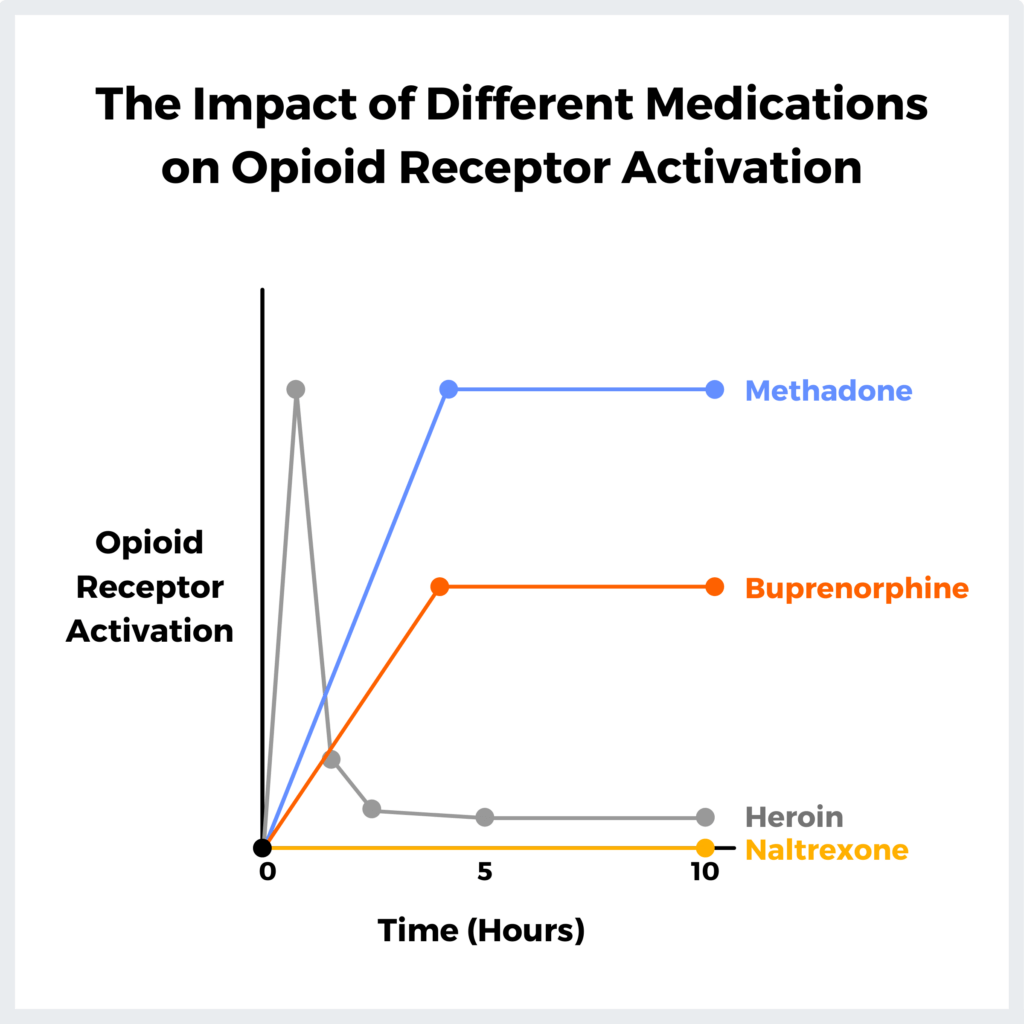
Agonists used therapeutically to maintain a more consistent rate of activation over longer time periods, reducing the effects of withdrawal. Heroin activates opioid receptors fully and quickly, with a steep drop-off. Methadone (blue) is also a full agonist, but the activation is much slower and longer lasting.
Partial Agonists
Partial agonists also bind fully with the opioid receptors in the brain, but have lower activation ceilings than full agonists and have diminishing effects at higher doses, limiting their potential for misuse. This category includes Buprenorphine and and increasingly common formulation called Suboxone, which combines Buprenorphine and Naloxone to further prevent misuse.
Partial agonists used therapeutically maintain a more consistent rate of activation over longer time periods, reducing the effects of withdrawal. Heroin activates opioid receptors fully and quickly, with a steep drop-off. Buprenorphine (orange) activates the receptors partially, with a similar time course to that of methadone.
Antagonists
Agonists bind fully with the opioid receptors in the brain, but therapeutic dosages have lower degree of effect than commonly misused opioids. Some agonists, like methadone, can be used to reduce withdrawal symptoms without providing the same degree of euphoria or sedation. However, the cumulative effect of large doses of methadone can approach the effects of other opioid use; as such, methadone requires observed dosing, oftentimes in a clinical environment.
Agonists used therapeutically to maintain a more consistent rate of activation over longer time periods, reducing the effects of withdrawal. Heroin activates opioid receptors fully and quickly, with a steep drop-off. Methadone (blue) is also a full agonist, but the activation is much slower and longer lasting.
-
Agonist (Blue) Agonists
Agonists bind fully with the opioid receptors in the brain, but therapeutic dosages have a lower degree of effect than commonly misused opioids. Some agonists, like methadone, can be used to reduce withdrawal symptoms without providing the same degree of euphoria or sedation. However, the cumulative effect of large doses of methadone can approach the effects of other opioid use; as such, methadone requires observed dosing, oftentimes in a clinical environment.
Agonists used therapeutically to maintain a more consistent rate of activation over longer time periods, reducing the effects of withdrawal. Heroin activates opioid receptors fully and quickly, with a steep drop-off. Methadone (blue) is also a full agonist, but the activation is much slower and longer lasting.
-
Partial Agonist (Orange) Partial Agonists
Partial agonists also bind fully with the opioid receptors in the brain, but have lower activation ceilings than full agonists and have diminishing effects at higher doses, limiting their potential for misuse. This category includes Buprenorphine and and increasingly common formulation called Suboxone, which combines Buprenorphine and Naloxone to further prevent misuse.
Partial agonists used therapeutically maintain a more consistent rate of activation over longer time periods, reducing the effects of withdrawal. Heroin activates opioid receptors fully and quickly, with a steep drop-off. Buprenorphine (orange) activates the receptors partially, with a similar time course to that of methadone.
-
Antagonist (Yellow) Antagonists
Agonists bind fully with the opioid receptors in the brain, but therapeutic dosages have lower degree of effect than commonly misused opioids. Some agonists, like methadone, can be used to reduce withdrawal symptoms without providing the same degree of euphoria or sedation. However, the cumulative effect of large doses of methadone can approach the effects of other opioid use; as such, methadone requires observed dosing, oftentimes in a clinical environment.
Agonists used therapeutically to maintain a more consistent rate of activation over longer time periods, reducing the effects of withdrawal. Heroin activates opioid receptors fully and quickly, with a steep drop-off. Methadone (blue) is also a full agonist, but the activation is much slower and longer lasting.
Prior to starting any medication or treatment plan always consult a medical doctor or other qualified healthcare provider regarding questions that you may have about any past, present, or suspected medical conditions and how those medical conditions may be impacted by starting any medication or treatment plan.