OUD Treatment Options

Finding Your Path to Recovery
Continued treatment after detox is crucial for many, as eliminating substances from the system does not treat the underlying condition of SUD/OUD and can lead to greater risk of resumed use.
Treatment programs can offer a range of support depending on clients’ needs. Inpatient treatment, residential treatment, and outpatient treatment programs are designed to address substance use disorder at various levels of severity.
It is best to consult a professional to determine which type of program will best fit your needs.
Inpatient Treatment
Inpatient treatment provides the most intensive level of care and supervision. Hospitals, and some treatment centers, have trained medical staff available 24/7 to ensure the safety and wellbeing of their patients, which can be especially important during the detoxification period. The goal is to transition the patient into a less intensive setting, after a short stay during which symptoms of dependence and withdrawal are stabilized.
Note that the term “inpatient treatment” is often used interchangeably with “residential treatment”, so be sure to clarify the type of care offered at a specific facility.
- Short term (average stay is a few days)
- Involves intensive care and supervision at a live-in facility
- Medical staff available 24/7

Residential Treatment
Residential treatment also takes place at live-in facilities, though these programs do not necessarily offer the round-the-clock medical staffing present in a hospital environment. Oftentimes patients exiting inpatient treatment will transition into residential treatment. These programs typically last for longer period of time: the average stay is 30 days, but can last up to 90 days or 6 months, depending the severity of the use disorder, mental health problems, and previous treatment experience.
Residential treatment programs often provide access to therapy, support groups, and social services for their participants. This may include family counseling and activities to help build trust and repair personal relationships.
- Intermediate-term (average stay is about 30 days)
- Live-in facility
- Medical staff is available during specific hours
Outpatient Treatment
Outpatient treatment provides more flexibility, but requires high levels of commitment and motivation from participants. This form of treatment allows for the client to stay in their own residence while attending treatment programming during the day, which can allow clients to remain close to their family and loved ones. This can be less disruptive to clients’ routines and responsibilities, but still involves regular check-ins to monitor progress. Outpatient treatment is oftentimes more affordable than residential programs, because lodging is not included in the cost.
Outpatient programs may vary in intensity and duration, but typically last anywhere between 3 months and a year.
- Intermediate to long-term (average program is 3 months to 1 year+)
- Commute to treatment
- Medical staff available at facility
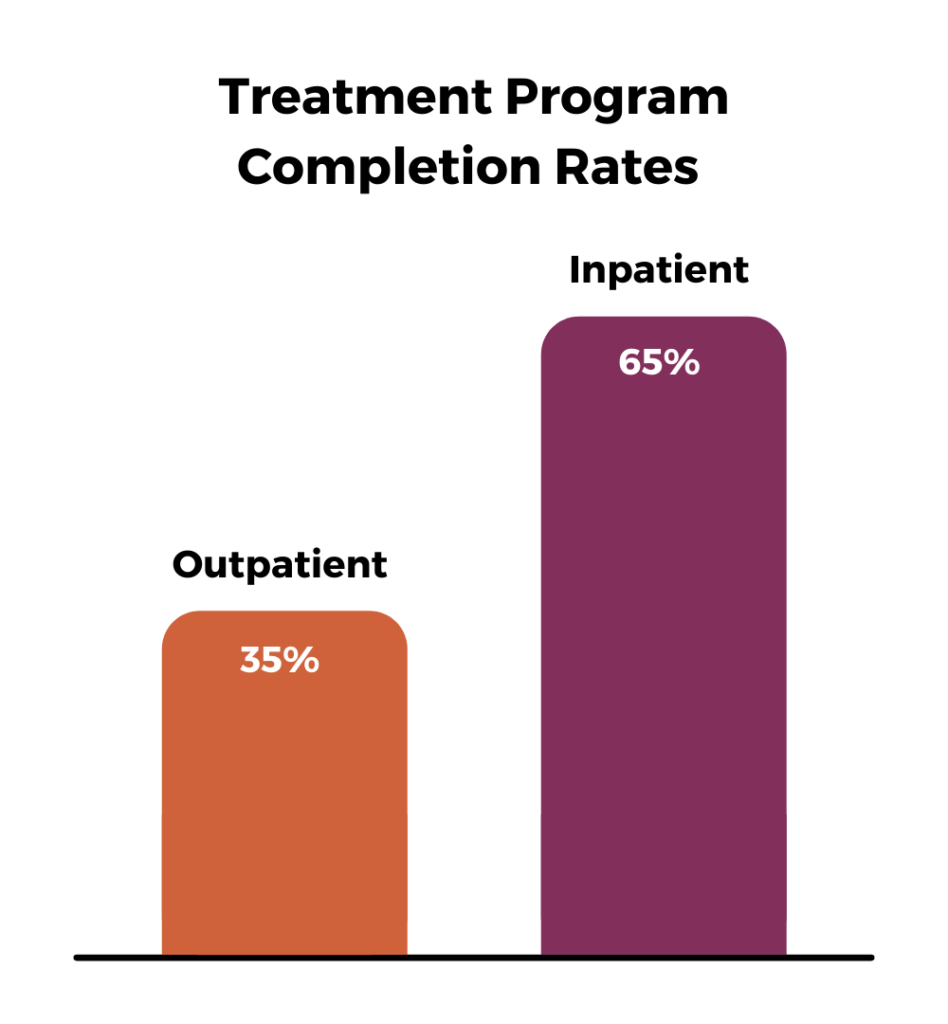
Inpatient programs tend to see higher rates of program completion (65%) when compared to outpatient treatment (35%).
Treatment Outcomes by the Numbers
While individual outcomes vary from person to person, studies show that all three forms of treatment outlined above can be effective in improving outcomes for individuals with substance use disorder. Studies have found that opioid misuse may decrease by up to 90% after initiating MAT. One study found that long term treatment had a high correlation to improved treatment outcomes; people hitting certain treatment thresholds were five times more likely to remain abstinent after one year. NIH recommends 90 days in treatment as a key milestone for ongoing recovery.